Back to SCI-FI ART
ILLUSTRATORS & WRITERS OF THE FUTURE CONTEST
10/15/00
The L. Ron Hubbard Illustrators of the Future and Writers of the Future are two parallel awards for new artists and authors. The contest was created by L. Ron Hubbard and is administered by Author Services, but - I know you're wondering - kept strictly separate from the Scientology stuff. None of the judges are Scientologists. Hundreds and thousands of amateurs compete every quarter to be one of three quarterly winners for the contests. The quarterly prizes for illustrators are $500; for authors, it's more (but we won't go there). Authors submit an unpublished story; illustrators submit a small portfolio of three pieces. It's for amateurs; you can't have written three published short stories or a novel if you're a writer, or had three black and white or one color illustration published in a magazine or book if you're an artist. Most of the writers submit many, many times before they become quarterly winners. It took me (Frank Wu) three tries to become a quarterly illustration winner - and good thing that I finally made it. I basically entered the last quarter I was eligible, because I'd since gone on to have work published. The contests are and have been judged by famous and important science fiction writers like Kevin J. Anderson (who wrote several Star Wars novels), Larry Niven & Jerry Pournelle (Niven's Tales of Known Space, Lucifer's Hammer, Mote in God's Eye), Anne McCaffrey (the Pern dragon novels), Frederik Pohl (Space Merchants, Gateway), not to mention Gregory Benford, Algis Budrys, Eric Kotani, Tim Powers, Robert Silverberg, Jack Williamson, and Dave Wolverton. Illustration judges have included folks like Frank Frazetta, Frank Kelly Freas, Laura Brodian Freas, Edd Cartier, the late Paul Lehr, Leo and Diane Dillon, Bob Eggleton, Vincent Di Fate, Will Eisner and Ron and Val Lakey Lindahn. Many of the writing and illustration winners themselves have gone to fame and fortune. (Nina Kiriki Hoffman and K. D. Wentworth are among them; Kevin J. Anderson and Dave Wolverton were winners before becoming famous authors and judges themselves. Wolverton's Grand Prize-winning story "On My Way to Paradise" was the basis of his first novel.)
At the end of each contest year, each of the twelve (3 winners per quarter) illustrator winners is assigned one of the 12 quarter-winning stories to illustrate. The judges decide which illustration they like best, based mainly on the criterion of which story most makes them want to read the story. That illo gets the Grand Prize, the L. Ron Hubbard Gold Award - a big trophy and $4000. The three stories per quarter were ranked (first, second and third), and the judges picked the Grand Prize from among the four first place winning stories. The guy who won the Grand Prize in writing, Gary Murphy, won with the second story he'd ever written - doesn't that just kill you?
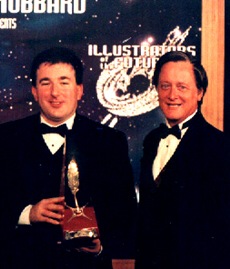
Gary Murphy and Tim Powers
The awards are actually given out in a gala annual banquet; it was really a Big Deal. We were all dressed up in tuxedoes, and there were various luminaries from the science fiction world. A lot of the judges mentioned above, plus a lot of Hollywood people, like Roger Christian, who won an Oscar for his work on the original Star Wars and who directed Battlefield Earth; and Patricia Tallman, who played Lyta in Babylon 5. Plus lots and lots of photographers and video cameras to record it all. All pretty spectacular.
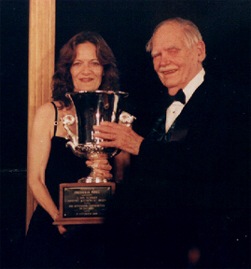
Here's Frederik Pohl being given a lifetime achievement award at the awards banquet.
Before the awards banquet, we were flown in from all around the world... all over the U.S., plus Canada and as far away as Scotland. One of the quarterly winners was trying to come from Ukraine, but she couldn't get out of the country. This was really too bad, because her artwork was just spectacular. We arrived early for weeklong seminars on writing and art. We artists had it easy; we hung out with Ron Lindahn and Val Lakey Lindahn (really good illustrators and authors of How to Choose Your Dragon and Olde Misses Milliwhistle's Book of Beneficial Beasties). We just sat around and talked about art and went to barbecues and looked at art and visited to art museums, and picked at each others' portfolios. The writers had it tough; we couldn't hang out with them much because they were busy writing and writing and writing; Tim Powers had them writing a whole short story in the few days that we were there.
We also saw the debut of the book, L. Ron Hubbard Presents Writers of the Future, Vol. XVI, which had our various illustrations and stories in it.
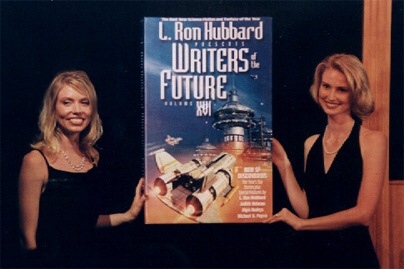
This is a mock-up: neither the book is that big, nor the girls that small...
It was so cool, to actually be in a book. I had already seen my stuff in magazines before, but never in a book. Most of the illustrators had never seen their work published anywhere. It was a strange mixture of excitement and disappointment. We were each paid $125 for book publication rights for our illos (but the authors were paid more for their stories, but we won't go there either). However... The illustrators were, well, a little dark. Some of the more cartoony ones survived fine. But detail was lost in others, including mine on page 187 - which I had done with the painstaking dot dot dot technique of the great 1930's to 1950's illustrator Virgil Finlay. All my dot dot dots bled together into one dark blob blob blob. Yikes. We were supposed to autograph a whole bunch of the books for people, and while other people were done signing their names on books, I was still going. I decided that I was going to hand re-draw the dots and the lines that had disappeared in printing. Ron Lindahn asked me if I was going to fix up all the thousands of books that had been published. I said, yes, if my hand holds out. I stopped at a few dozen - so if you get one of those, it's going to be worth a lot of money some day.
There were a couple other little glitches in the publishing. Jayson Doolittle's illustration on page 257 is actually upside-down. Oops. This will make a great story when he's famous ("My first published piece of artwork was printed upside-down!"). After all, it's been noted that the mistakes (like the upside-down airplane stamp) are worth more. Next time, he'll learn to write the word "top" on an ambiguous illustration when he submits it.
Another little error in the book victimized Steelee Faltis. Steelee is this cool guy from Oakland who's into skateboarding and wants to work in animation. He's tall and thin, but the really remarkable thing about his physical appearance is that he is completely hairless - his hair fell out a few years ago and didn't grow back. Must be a genetic thing. His parents and everybody else in his family has hair - but not him. No hair on the top of his head, no hair on his arms, no eyebrows, no eye lashes. Nothing. Here's a picture of Roger Christian signing his autograph on Steelee's bald head:
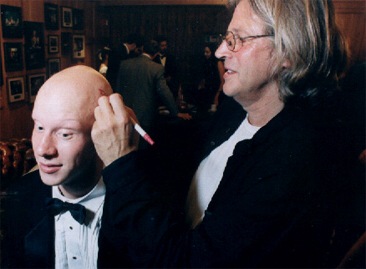
Steelee Faltis and Roger Christian
But, you may notice from my text and the picture that Steelee is, well, a guy. When we submitted little bios to the published along with our pictures in the book, we wrote them as "I did this and I did that." But the publisher changed all the I's to he's and she's. Through the sex-changing magic of copy-editing, Steelee became a female in his bio on page 274. Ooops. The book is available through Amazon, so you get your own copy and check out the oddities yourself.
Another fun story: At rehearsal for the awards ceremony, we found out that we were each supposed to go up to the podium and give a little thank you speech while accepting our quarterly prize - this big plaque. We were all a little nervous about giving speeches, but one fellow, Justin Phillips, was literally speechless. This is the guy who had been flown in from Scotland, but he was apparently painfully shy. Even though we artists had hung out as a group for several days, I had hardly heard him say more than four or five sentences. Despite this, he was establishing himself as a creator of cool fantasy prints - pegasuses and unicorns, things like that. But he was so shy. As soon as he heard that we would have to give little speeches, but just bolted. Gone. He didn't even come to the awards ceremony. Didn't show up in any of the photos. I heard a report of one Justin sighting, sitting alone in a patio, but I never saw him again. Nobody knew where he was - not even his wife or girlfriend (we weren't sure which she was). It was so odd. And kinda rude, I thought, since Author Services had brought us all down there and put us up at a hotel and kept feeding us. Rude.
But the rest of us lumped it and gave little speeches when we accepted our quarterly awards. I thought up a little speech that went something like this:
"First I'd like to thank L. Ron Hubbard for creating this award, and Author Services for running this contest. It is so hard for new authors and illustrators to get any sort of encouragement or support, but this contest really fills that void. Also, I'm standing here gladly accepting this award, but I really feel like standing here in my place should be Frank R. Paul and Frank Kelly Freas and Frank Frazetta and Umberto Boccioni and Vincent DiFate and Ron and Val Lakey Lindahn and James Bama and all the other great science fiction illustrators who have come before. Everything I do is an extension, a reiteration, a repetition of what they've already done. If we see further, it is because we stand on the shoulders of giants. Thank you. I love you all."
When I spoke the "shoulders of giants" quotation, which is attributed to Newton, there was an audible "ooooh" from the audience. A lot of people had gotten the audience to laugh, but I was the only one who got them to oooh.
When it came time to announce the grand prize winners, I really didn't think it was going to be me. I thought it was going to be the woman from the Ukraine, Yana Yadoshchook, whose illustration was an amazingly detailed piece with this sailing ship in space, with a meteor-pockmarked moon and even a lionfish. Amazing work. I thought it was going to be her. I wondered who was going to accept her award if she won, but wasn't there.
Or maybe I thought the Grand Prize winner was going to be Jayson Doolittle, the golden boy - and I really mean "boy," because he was only 17 when he won the quarterly contest. And here I am, over twice as old (I was the oldest illustration winner), struggling to get anywhere with art, struggling to get into magazines and sell stuff at conventions - and a lot of this kid's art is better than mine - we saw his sketchbook, and I had to avert my eyes. It was like looking into the face of God - and I couldn't take it. I had to look away. I felt like Salieri in Amadeus overwhelmed by the sight of Mozart's musical notations. Seeing Jayson's fabulous work - really intricate design work and scrolls and incredible anatomical studies and... I can't even talk about it, it was so good. And here he is, this really nice guy, a thin and gawky little... kid! And his parents were illustrators, which was such an unfair advantage. My parents couldn't draw beans. Literally. I asked my dad to draw a car once and it looked like a matchbox - not a Matchbox(TM) car, the cool little toy cars, but a matchbox - a box you put matches in. Urk. And here his kid has an unfair advantage, and he's so talented... and... And only a kid. You just wanted to kill him - in the nicest sort of way, I mean.
So I had no expectation really of winning the Grand Prize award. So when they announced my name, I really was totally, utterly, completely shocked. I walked up to the podium with my mouth hanging open and then, out of desperation for something to do I grabbed the trophy, which is huge, and lifted it up into the air, shouting, a la James Cameron:
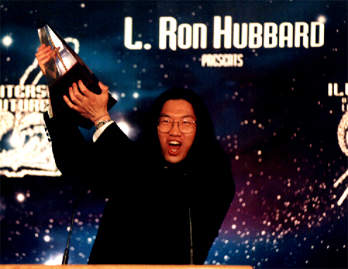 "I'm king of the world!"
I really didn't have another speech. I'd shot my wad with my first speech, and hadn't expected to be giving another. But one of the other quarterly winners, Samantha Miceli, had said that one year the Grand Prize winner had the other winners join him on stage. I wanted to do that, since these people were all my friends, and I'd seen their work, and it was all really good. Really, any one of us could have won. So I asked them all to join me up on the stage:
(This is actually a later, posed picture of us all on stage, but it looked something like this:)
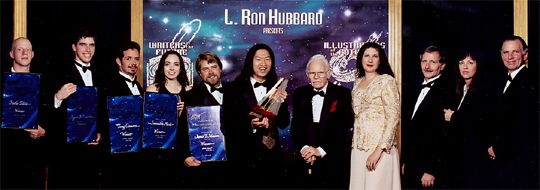
Illustration Winners: Steelee Faltis, Jayson Doolittle (the kid), Troy Connors, Samantha Miceli, James Johnson, Frank Wu (me), and Illustration Judges: Frank Kelly Freas, Laura Brodian Freas, Vincent DiFate, Val Lakey Lindahn, and Ron Lindahn.
All in all, it's been a great experience. And it continues. Bridge Publications, the book's publisher, is working hard to generate publicity for us and the book. Author William Brown appeared with Shaq O'Neal and had his picture with him on the AP news service. The photo of Roger Christian signing Steelee's head made it on AP news, too. Various of us winners have appeared in TV and in newspaper articles about us and the contest. And we are going to book signings everywhere. Last week, I went to the Northern California Independent Booksellers Association conference (perhaps it would be best if you bought the book through your local bookstore rather than Amazon - ahem), and signed books there. It was fun - we had a little display, and I had my trophy and a framed version of the illo. People walked by, uncaring, but when we shouted out, "Do you want an autographed book?" it got folks' attention. And I had my little spiel down... "Hi, I'm Frank Wu, and this is my award-winning illustration, and this is my award I won for my illustration, and this is the book my award-winning illustration appears in..." Gets 'em every time.
Oh, I should show you my illustration so you know what I'm talking about:
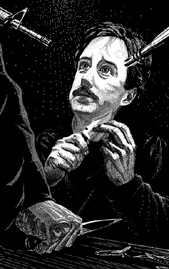 Illo for "The Guildmaster"
The story itself, which is written by Dan Dysan (pen name of Dan Eater) is about a post-apocalyptic world. Our hero is being interrogated in a prison of war camp; they are basically executing everyone who can't prove he's useful. Our hero is trying to prove he's useful because he's a blacksmith and knows how to make knives. Lucky for him, and for us, because otherwise there wouldn't be a story.
So that was my experience with the Illustrators and Writers of the Future Contest. The contest itself is on-going. If you're a new writer or illustrator, please enter. There's not much opportunity for new creators to get much recognition or promotion, but this is it. You can visit the contest website for details here.
Here are some more Illustrators/Writers of the Future photos for your amusement:
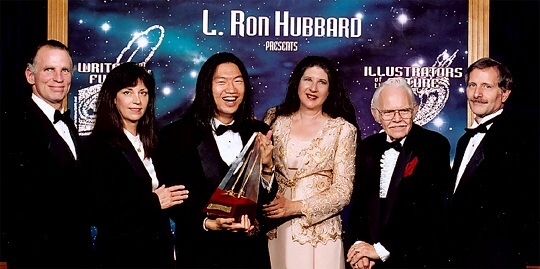
Me, surrounded by illustration judges: Ron Lindahn and Val Lakey Lindahn, Laura Brodian Freas, Frank Kelly Freas, and Vincent DiFate
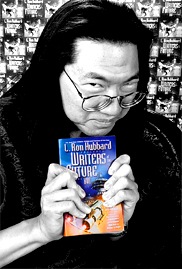
We were supposed to have our picture taken with the book... Here I am:
And a photo of almost all the winners, writers and illustrators...
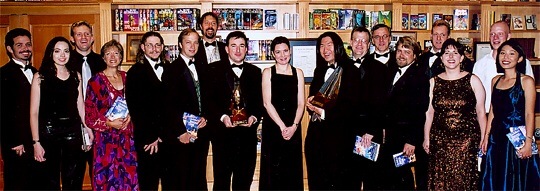
...except for Justin Phillips.
Back to Science Fiction art
Back to Science Fiction and Humor Writing
Back to The Official Frank Wu Website homepage
Email to Frank Wu